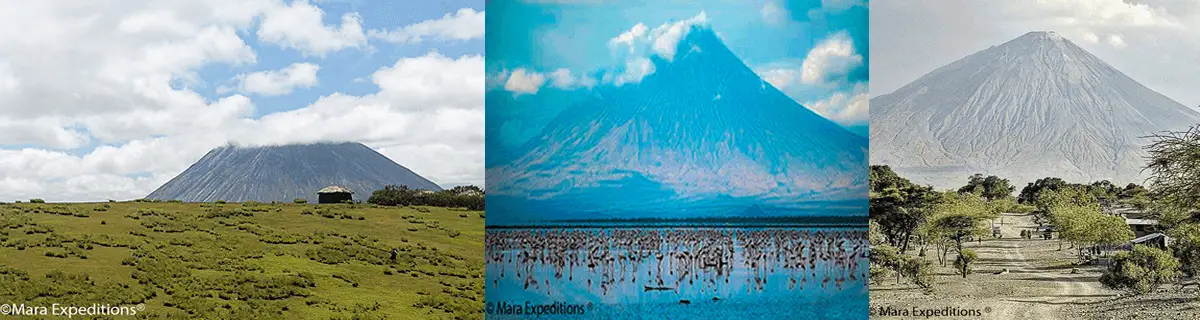
Mt Ol Doinyo Lengai climb from the south of Lake Natron in the eastern Rift Valley of North Tanzania. Maasai refer to it as “the sacred mountain of God.”
Known by the Maasai people as the “Mountain of God”, Ol Doinyo Lengai is nothing short of spectacular. Ol Doinyo Lengai rises majestically from the Great Rift Valley floor to a height of 2890m. It is the only active volcano on the planet that erupts carbonatite lava. This type of lava is very unique because of low temperatures of around 500°C, about half the temperature of normal basalt lavas. Its lava flows with a viscosity almost as fluid as water.
Described by others as a scientifically precious, geochemical shrine, Ol Doinyo Lengai is quite a physically demanding climb. Its steep slopes are a challenge to ascend as well as to descend. The daytime heat is also unbearable. The best time to climb the mountain is at night, when the temperatures are lower. This gives the climber an amazing sunrise view at the summit. Descend before the scorching heat kicks in. Given the long transfer distance, it is best to trek Ol Doinyo Lengai as part of a 3-day tour.
Below is a standard 3-day itinerary for Ol Doinyo Lengai. Keep in mind that this climb can be an addition to a longer safari tour, depending on your preference.
Mount Ol Doinyo Lengai, in a nutshell:
Location:
Mount Ol Doinyo Lengai, often simply referred to as Lengai, is located in the East African country of Tanzania, near Lake Natron. It is on the floor of the East African Rift System and is known for its unique volcanic activity.
Volcanic Activity:
Ol Doinyo Lengai is one of the few active carbonatite volcanoes in the world. Its eruptions are relatively rare. It is characterised by the eruption of a unique type of lava called natrocarbonatite. The lava is cooler and darker than the typical silicate lavas found in most volcanoes. The presence of this lava makes Lengai’s slopes challenging to navigate.
Terrain:
The slopes of Mount Ol Doinyo Lengai are steep and rugged, consisting of loose scree and volcanic ash. Climbers must be prepared for difficult footing and challenging ascent conditions. The ascent can be particularly demanding due to the loose volcanic material underfoot.
Altitude:
While Mount Ol Doinyo Lengai is not as high in elevation as some other famous African peaks, such as Mount Kilimanjaro or Mount Kenya, it still reaches an elevation of over 2,800 metres at its summit. Altitude-related challenges can still be a factor, especially for those who are not acclimatised to higher elevations.
Cultural Significance:
Mount Ol Doinyo Lengai holds cultural significance for the Maasai people who live in the surrounding region. It is considered a sacred mountain in Maasai culture, and climbers are expected to respect local customs and traditions while on the mountain.
Views:
Despite the challenging climb, reaching the summit of Mount Ol Doinyo Lengai offers stunning panoramic views of the surrounding landscape, including Lake Natron and the Rift Valley. On clear days, climbers may even catch a glimpse of Mount Kilimanjaro in the distance.
Climbing time:
Due to its location on the floor of the Rift Valley, it is generally hot during the day. It is best climbed in the wee hours of the night, reaching the summit for sunrise. You get back to the camp before the heat of the day rises.
Overall, climbing Mount Ol Doinyo Lengai is a unique and memorable adventure for those seeking a challenging ascent and the opportunity to witness the raw power of an active volcano in a remote and beautiful part of East Africa.
Day 1: Nairobi to Lake Natron Camp
Day 1: Depart Nairobi early in the morning and drive to Lake Natron Camp (the transfer is around 7 hours). Here you will be able to freshen up and then visit the Ngare Sero Waterfalls, which descend from the Nguruman Escarpment west of Lake Natron. After your tour of the waterfalls, you will head back to the camp for dinner and overnight.
Day 2: Full-day Lake Natron.
After breakfast, you will be transferred to Lake Natron, an alkaline lake. It serves as the principal breeding site for three-quarters of the world’s population of Lesser Flamingoes. After your tour of Lake Natron, you will head back to the camp so as to get enough rest before your trek up the mountain at midnight.
Day 3: Summit climb – Nairobi
Your climb will start at midnight, and it will take around 5 to 6 hours until you reach the summit in time to witness the amazing sunrise as it illuminates the Great Rift Valley. During your night climb, you will be escorted by an experienced Maasai guide. After exploring the peak, you will head back down the mountain to the base, where your driver will be waiting for you to take you back to the camp to rest and freshen up. You will then be transferred back to Nairobi via Ngare Sero Maasai village, where you will be able to visit the Maasai bomas and experience their ways of life.